678
'Purple Robe' cultivar
A honey-scented June
If you've ever walked down a Toronto street in late May or early June and hit a sudden wall of honey smell that made you stop and look around — that was probably a black locust. The flowers hang in long drooping racemes, pure white with a yellow spot at the throat, and when they open they release a sweet, almost tropical fragrance that carries. Bees lose their minds. "Acacia honey," despite the name, is mostly black-locust nectar — Robinia is in the pea family and not actually an acacia.
The 'Purple Robe' cultivar (678 of Toronto's 2,943 locusts) has pink-magenta flowers instead of white. Same perfume, different colour.
The hardest wood in the neighbourhood
Black locust wood is extraordinary: one of the hardest North American hardwoods (Janka rating ~1700, harder than red oak), almost completely rot-resistant (lasts 50–100 years as an untreated fence post in ground contact), and dense enough to sink in water when green. It was the traditional wood for ship "trunnels" (the wooden pegs that held hulls together before steel fasteners), for mine timbers, for rail ties, for any application where rot in soil or water would be fatal. A colonial-era expression was "a locust post outlasts a cedar house."
The tree's own habit reflects this. Locust limbs are brittle and often break in storms, but the exposed wood doesn't rot — it just sits there, sun-bleached to silver, for decades. If you see a locust that looks half-dead, keep looking: often the "dead" half is actually ten-year-old heartwood that just hasn't gotten around to decaying.
A nitrogen fixer on your street
Like its pea-family cousins (soy, clover, alfalfa), black locust fixes atmospheric nitrogen through root-nodule bacteria. It's one of the very few nitrogen-fixing trees in Toronto's inventory — the others are mainly Kentucky coffeetree (also pea family) and the increasingly rare native alders along ravine edges. A mature locust is doing roughly the fertilizer work of a small legume cover crop, for free, adjacent to your sidewalk. The grass under locust trees is noticeably greener than under maples, for this reason.
This is also why locust is a classic pioneer species on disturbed ground — old quarries, abandoned pastures, railway cuts. It moves in fast, fixes nitrogen, creates shade for successors. Which, combined with its thorny twigs and aggressive root suckering, makes it invasive in much of Europe, where it was introduced in the 1600s. Toronto is on the eastern edge of its North American native range (the core is the southern Appalachians and Ozarks); here it's a deliberate plant, not a weed.
Where Toronto's locusts live
The top five neighbourhoods:
| Neighbourhood | Black locusts |
|---|
| High Park-Swansea | 131 |
| Casa Loma | 115 |
| Bridle Path-Sunnybrook-York Mills | 99 |
| West Humber-Clairville | 97 |
| Edenbridge-Humber Valley | 81 |
And the most concentrated streets:
| Street | Neighbourhood | Locusts |
|---|
| Bloor St W (Etobicoke) | Etobicoke City Centre | 55 |
| Wynnview Crt | Birchcliffe-Cliffside | 35 |
| Davenport Rd | Corso Italia-Davenport | 35 |
| Wychwood Park | Wychwood | 30 |
| Parkside Dr | High Park-Swansea | 23 |
| Woodland Hts | High Park-Swansea | 22 |
| Lewes Cres | Bridle Path-Sunnybrook-York Mills | 22 |
A few of these deserve comment. Wychwood Park (the 1907 artist-enclave heritage district near Christie-Davenport) having 30 locusts on one short private street is a specific planting decision, probably the original landscaping when the neighbourhood was laid out. Davenport Road runs along the old Lake Iroquois shoreline — the "escarpment" above which old-money Toronto looks down — and its locusts likely date to late-1800s street plantings. The Bloor St W in Etobicoke entry is a long post-war arterial where locusts were chosen for their tolerance of salt and compacted soil.
The giants
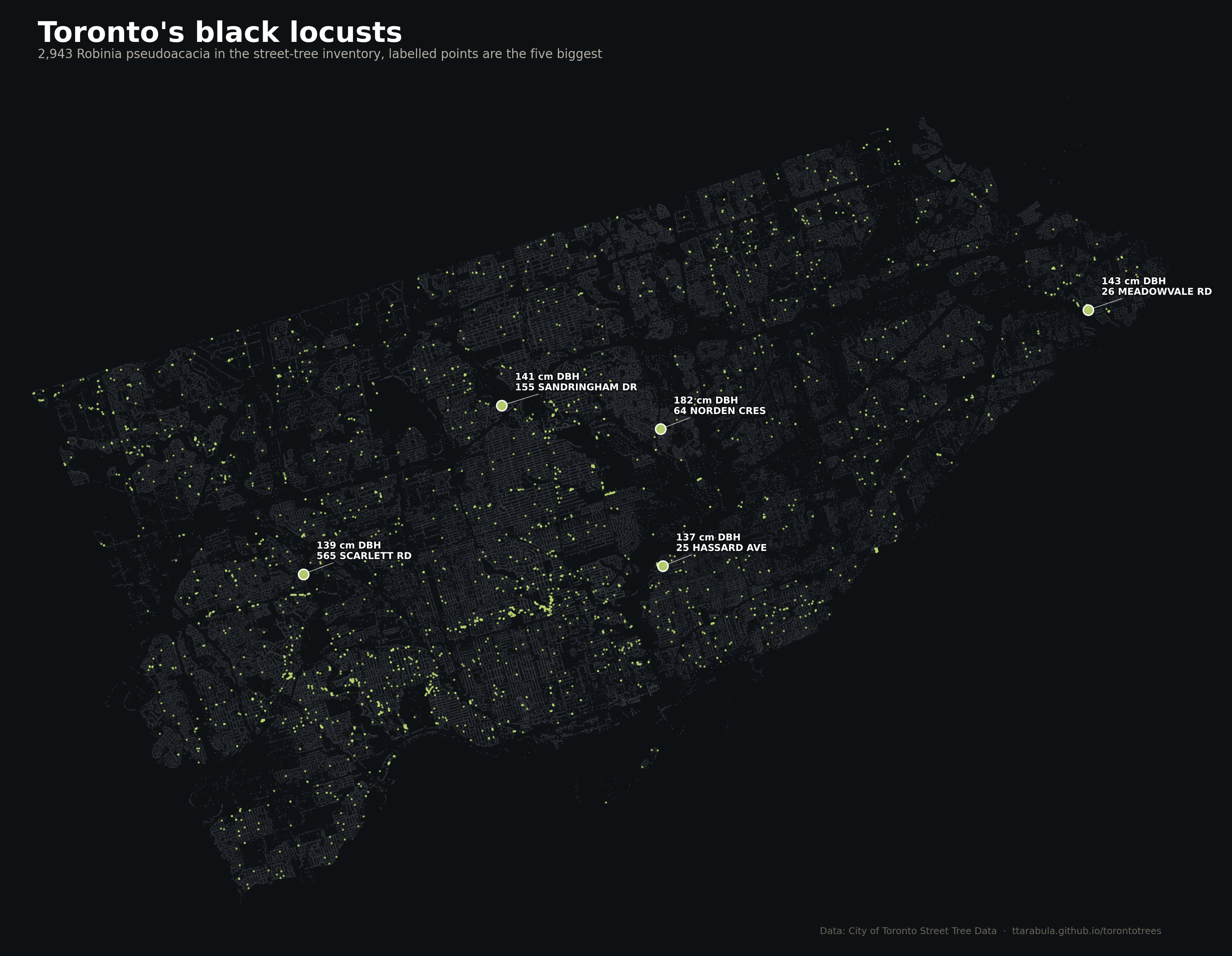
The five biggest black locusts in Toronto's inventory, by diameter at breast height (roughly 1.3 m above ground):
The Norden Crescent specimen at 182 cm DBH is a very large black locust. Black locusts typically max out around 25 m tall and 120 cm DBH; the species isn't famous for longevity (rarely past 100 years, often less, because of heart-rot in a wood that paradoxically rots from the inside when alive even though it doesn't rot once cut). A 180-cm specimen on the street-tree roll is borderline unheard of — that's probably a 150+ year-old tree that predates the modern city's arrival in that part of Don Mills.
The honey locust confusion
Toronto has way more honey locust (Gleditsia triacanthos, 59,975 trees) than black locust (Robinia pseudoacacia, 2,943). They're different genera — both in the pea family, but not close relatives. Honey locust has feathery bipinnate leaves and long twisted seed pods; black locust has once-pinnate leaves and shorter straight pods. Honey locust flowers are tiny and green, practically unnoticeable; black locust flowers are white, showy, and scented. If the tree smells like honey in June, it's a black locust. If you can barely tell it's flowering, it's a honey locust.
(The "honey" in honey locust comes from the fruit — the pulp inside the pods is sweet, eaten by livestock. Black locust's name comes from the rot-resistant wood used for "locust posts," though the Doctrine of Signatures crowd in the 17th century thought its seed pods looked like the biblical locusts that fed John the Baptist. Etymology is weird.)
A laneway tree
The black locust is a good laneway tree. Laneways in Toronto are 4-metre-wide paved corridors between backyards, with minimal soil volume, variable sun, salt spray, compacted fill, and chaotic drainage. Most ornamental trees sulk in them. Black locust thrives: it tolerates compacted dry soil, fixes its own nitrogen, grows fast when young, casts dappled rather than dense shade (so understory plants don't die), and has a deep taproot that doesn't heave pavement. The seed pods don't litter messily. The flowers smell wonderful in early June for about ten days.
It also throws out aggressive root suckers given half a chance, has thorns on young branches, and drops brittle limbs in ice storms. It's not a polite tree. But it's a useful one, and a beautiful one, and — because Toronto favours honey locust by about 20 to 1 for new plantings — increasingly an unusual one.
If there's a black locust near you, late May to early June is when to pay attention. The scent carries half a block.
Curious about the trees on your block?
Search any Toronto address and see every street tree in front.
Look up an address →