May 2026 · on the city's quietest 50-year retirement plan
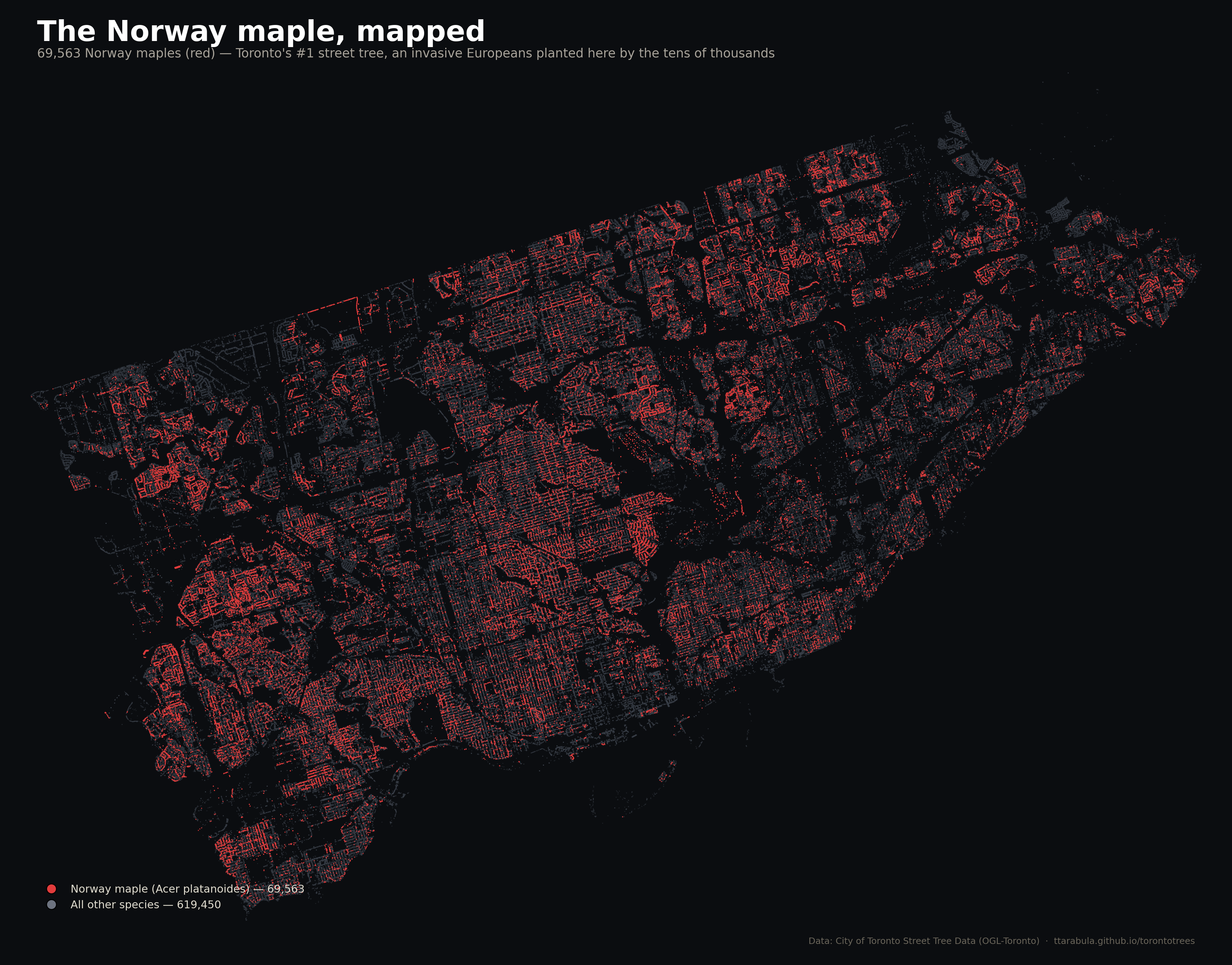
Take a walk down any pre-war Toronto residential street in summer. The canopy that closes overhead — the one that feels like it has always been there, the one you can hear in the wind — is, in most blocks, mostly a single species. Not native maple. Not Toronto's emblematic anything. Acer platanoides. The Norway maple. A European import the city planted by the tens of thousands between roughly 1955 and 1995, and the most successful single-species planting program in Toronto's urban-forestry history.
It is also a tree the city stopped planting around twenty years ago. It is on the Greater Toronto invasive-species list. It is implicated in the slow-motion collapse of native sugar maple regeneration in the Don Valley. It is not on the City of Toronto's approved planting list for streets, lawns, or boulevards.
And yet there are 99,931 of them in the city's street-tree inventory — 14.5% of every catalogued boulevard tree in Toronto. More than honey locust, more than Kentucky coffeetree, more than every native maple combined.
This post is about how that happened, and about what the city is quietly doing instead of cutting them down.
The Street Tree Data inventory doesn't record planting dates — only trunk diameters today. But trunk diameter is a rough proxy for age, and at 99,931 trees the rough proxy resolves into a clear signal. Here is the Norway-maple story by trunk size, alongside its share of every other tree at the same size:
| Trunk diameter | Norway maples | Share of all trees this size |
|---|---|---|
| Under 10 cm (saplings) | 4,447 | 1.8% |
| 10–30 cm (young) | 31,233 | 15.5% |
| 30–60 cm (mature) | 55,477 | 22.8% |
| Over 60 cm (canopy-providing) | 12,745 | 25.9% |
Read the right column from bottom to top. Of every street tree in Toronto with a trunk wider than 60 cm — i.e. the trees that are currently doing the actual canopy work — roughly one in four is a Norway maple. Of every sapling currently going into the ground, one in fifty is.
That collapse — from 26% to under 2% as you walk forward through time — is what a planting-program retirement looks like in slow motion. The city stopped buying Norway-maple stock from nurseries. The mature trees stayed where they were planted. The new saplings on every street are different species. The signature of the change is in the trunk-size distribution.
Norway maple was not always the wrong answer. It is, by every operational metric, an excellent street tree. It tolerates poor soil, salt, drought, compaction, urban heat, and the ten thousand small abuses inflicted on a tree growing inside a 2-metre boulevard strip. It transplants reliably. It puts on a metre of growth a year as a young tree. The crown closes on a residential street in fifteen to twenty years, fast enough that a planting program's politicians can be photographed under their own canopy. It produces a generic deciduous-tree shape — round, dense, broad — that satisfies almost everyone's mental image of "a tree on a street."
It also lives. Sugar maple, the native species it most resembles, hates streets — it sulks under salt, it scorches in hot summers, it dies young against curbs. Norway maple is what sugar maple's planting card would say if sugar maple read books and wanted to be an urban professional. For the post-war city looking to replace the elms killed by Dutch elm disease in the 1960s and 70s, it was, on every measurable axis, the right call.
The reasons are mostly downstream, and mostly about what Norway maple does to other things.
It seeds prolifically and the seedlings tolerate deep shade — including the deep shade thrown by the parent tree — which means it self-replaces under its own crown and excludes almost every native understory species. In the Don Valley, in Cedarvale Ravine, on the Lower Humber, on the slopes of every wooded ravine in the old city, Norway maple seedlings have spread downhill from the streets above and are slowly displacing the native sugar maple, beech, and oak that the ravines were built around. It is on the Ontario Invasive Plant Council's list of invasive species in Ontario.
It supports almost no native insects. Native oaks support 500+ species of native caterpillars and other Lepidoptera; sugar maple about 300; Norway maple, in most studies, fewer than 20. That number is the foundation of the food web that supports native bird populations. A Toronto streetscape that is 26% Norway maple at the canopy level is, ecologically, more like a parking lot than a forest.
It casts dense shade and exudes leaf chemicals that suppress the growth of plants underneath, which is part of why your front lawn is bare and patchy if you have a big Norway maple in the boulevard. It is shallow-rooted, which heaves sidewalks. It produces, in spring, the only consistent allergen-grade pollen of the Toronto street-tree palette.
None of this was hidden in the 1960s. But the operational virtues — fast, tough, cheap, photogenic — outweighed the ecological costs in the planting decisions of that era. The current decisions are made on different criteria.
If you want to see what the city is putting in instead, look at any of the 158 neighbourhood pages and read the top-five species for the new plantings. The contemporary list is consistent across most of the city:
The pattern is partly aesthetic, partly operational, but ecologically it is a deliberate widening — moving away from a single dominant species and toward a planting list that, if no one screws up the next forty years, will produce a more diverse Toronto canopy by the late 21st century.
Removing 100,000 mature street trees is not a thing a city does. The Norway maples standing on Toronto's streets right now are between thirty and seventy years old. The largest ones — the Banbury-Don Mills, Willowridge-Martingrove-Richview, West Humber-Clairville 1960s suburbs — are the canopy. Ripping them out would be politically catastrophic and ecologically counterproductive: even an imperfect tree throws shade, sequesters carbon, slows storm-water, and supports some insects.
The city's actual policy is the one revealed by the table at the top of this post: let them age out. Norway maple's typical urban lifespan is sixty to ninety years. Most of the existing street-tree population is in the 30–60-year band right now. Over the next forty years, they will reach end-of-life, be removed individually as they decline, and be replaced one-by-one with the species in the new planting list. By 2070, the Norway-maple share of the canopy will be substantially lower than 26% — without anyone ever having to defend a clearcut at a community meeting.
Once you can identify Norway maple — the five-lobed leaf almost identical to a sugar maple's, but with a milky sap that bleeds from a torn leaf stem (sugar maple bleeds clear) — you will see them everywhere. The crown is unusually dense and round, the bark a tight grey-black diamond pattern with sharp ridges that look freshly cut. In autumn the leaves turn yellow, not the orange-red of sugar maple — a tell from a block away.
Pay attention especially in the post-war suburbs (Don Mills, Willowdale, Etobicoke North, North York centre): a 60-year-old Norway maple every 15 m, on every block, on every street. It is the largest single planting decision Toronto ever made. Whether it was the right one is the kind of question urban forestry asks for forty years and then answers slowly, with hackberries and oaks.
Look up your block.
If you live in a Toronto post-war suburb, there's a 1-in-4 chance the biggest tree on your block is a Norway maple.
Search an address →