April 2026 · a pilgrimage guide
Toronto's rarest street trees — seven of the city's 689,013 trees are one-of-one
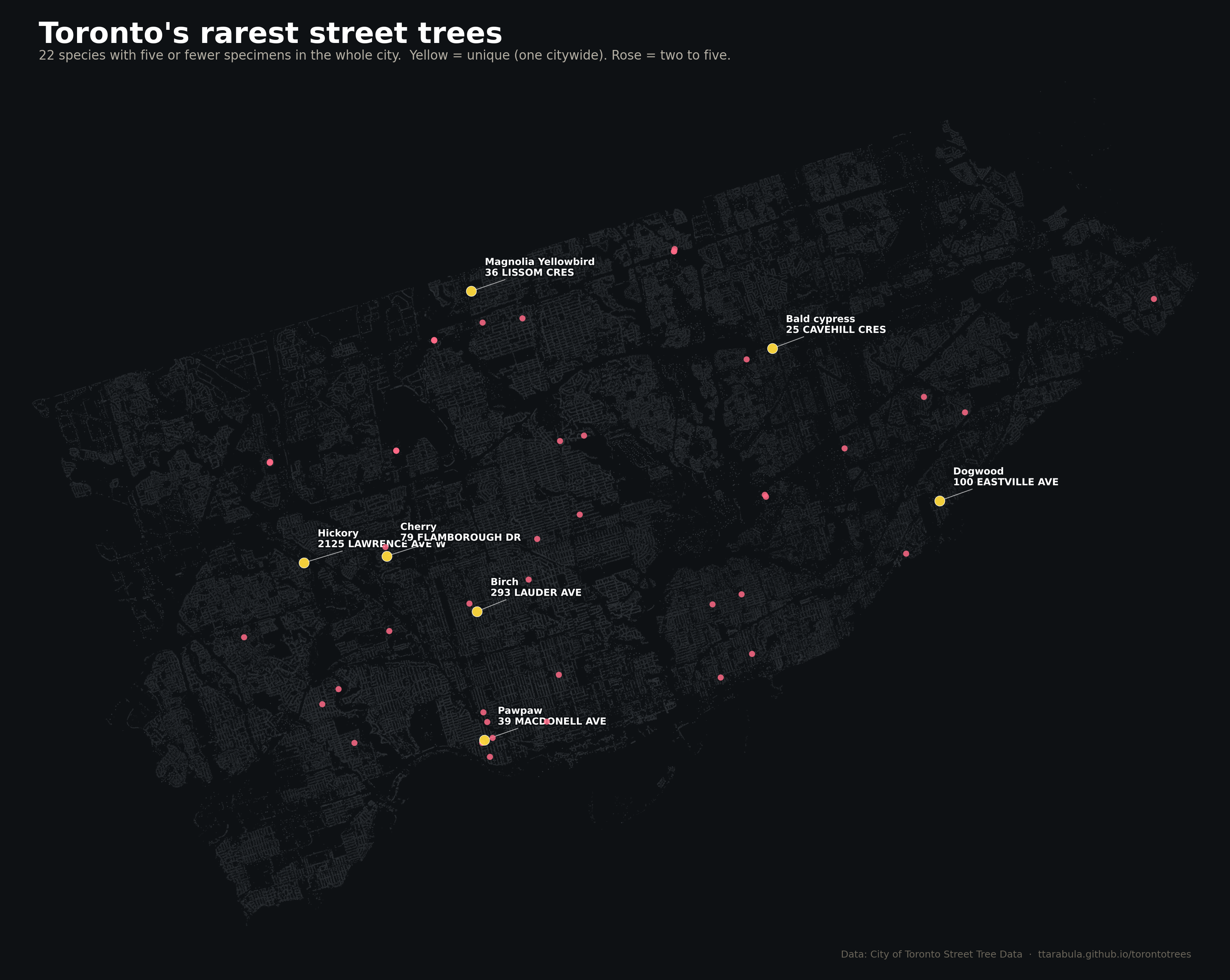
Toronto's street-tree inventory lists 192 distinct species. Seven of them have exactly one specimen in the entire city. Another fifteen have between two and five. That's twenty-two trees-species rare enough that if you visited every last individual, you'd see a third of the collection by early afternoon.
Here's where they are.
The seven one-of-ones
1
Pawpaw Asimina triloba
The largest native fruit in North America. Custard-fleshed, tastes somewhere between mango and banana, doesn't ship, basically unknown outside its range. Pawpaw is Carolinian, so it's at the northern edge of its natural range in southern Ontario. One Toronto street tree. This is the one.
2
Bald cypress Taxodium distichum
A deciduous conifer from the American southeast — think Louisiana swamps. Feathery needles that turn copper in November and fall off. The fact that one is surviving as a Scarborough street tree is a small triumph of climate resilience.
3
Yellowbird magnolia Magnolia × brooklynensis 'Yellow Bird'
A 1967 hybrid from the Brooklyn Botanic Garden — canary-yellow flowers instead of the usual magnolia pink-and-white. Blooms late enough to dodge frost damage. If you're in North York in late May, swing by.
4
Black birch Betula lenta
Also called sweet birch or cherry birch. The bark and twigs smell intensely of wintergreen when scratched — historically distilled into oil of wintergreen. Native to the eastern US. Easily Toronto's most scratch-and-sniffable street tree.
5
Pignut hickory Carya glabra
Native to southern Ontario but rarely planted as a street tree — the nuts are bitter (hence "pignut"), the branches drop heavy limbs in ice storms, and the tap root makes transplanting hard. A relict from when someone decided to try.
6
Sour cherry Prunus cerasus
The pie cherry. Montmorency cherry. The sour one your grandmother used. Blooms white in May, produces bright-red fruit in July. Toronto has exactly one on a city road allowance.
7
Grey dogwood Cornus foemina ssp. racemosa
A shrubby native dogwood — panicles of small white flowers in summer, white berries in fall that migrating birds strip within a week. Rare as a street tree because it's usually a naturalizing understory plant, not a boulevard specimen.
The next rarest (2–5 specimens citywide)
These are the second tier — species you'll stumble into a handful of times, across scattered neighbourhoods:
| Common name | Botanical | N |
|---|
| Smooth serviceberry | Amelanchier laevis | 2 |
| Crusade hawthorn | Crataegus crus-galli 'Crusader' | 2 |
| Glossy buckthorn | Frangula frangula | 2 |
| Siberian crabapple | Malus baccata | 2 |
| Canada plum | Prunus nigra | 2 |
| Broad-leaved linden | Tilia platyphyllos | 2 |
| Striped maple (moosewood) | Acer pensylvanicum | 3 |
| Sweet chestnut | Castanea sativa | 3 |
| Sawtooth oak | Quercus acutissima | 3 |
| American elderberry | Sambucus canadensis | 3 |
| Chinese poplar | Populus simonii | 4 |
| Whitebeam | Sorbus aria | 4 |
| State Street maple | Acer miyabei 'Morton' | 5 |
| Devil's walking stick | Aralia spinosa | 5 |
| Hop tree (wafer ash) | Ptelea trifoliata | 5 |
A few personal favourites on that list:
Striped maple (Acer pensylvanicum) — called "moosewood" because moose eat it. The bark is bright green with white vertical stripes. Looks unlike any other tree. Three of them exist, scattered across Toronto.
Sweet chestnut (Castanea sativa) — the European cousin of the American chestnut that was nearly wiped out by blight in the 20th century. Produces the chestnuts you roast at Christmas. Three Toronto street trees.
Devil's walking stick (Aralia spinosa) — name justified. Wickedly spined trunk, giant feathery compound leaves up to a metre long, enormous white flower panicles in August. Not quite tropical, but close. Five of them somewhere in Toronto.
Hop tree (Ptelea trifoliata) — a small native with papery winged fruit clusters that dangle like little hops. Used in beer before actual hops arrived. Five of them.
The caveat, as usual
This is street trees on city road allowances. There may be more of these species — possibly many more — in parks (the High Park oak savannah, the Leslie Street Spit), on institutional grounds (U of T, Casa Loma, Allan Gardens), in arboreta (the Toronto Botanical Garden has ~1,500 species), or in private yards. So "Toronto has one pawpaw" really means "Toronto's boulevard inventory has one pawpaw" — but that is, in itself, striking.
It also means each of these trees is doing outsized work: representing its species in the common-property strip where a Torontonian is most likely to encounter it unplanned. If you happen to live near one, you're the caretaker of the city's only specimen. If the tree dies and isn't replaced with the same species, that's zero.
Find the rare tree nearest you.
Search any Toronto address and see every street tree on your block.
Look up an address →