April 2026 · hall of fame
Toronto's veteran street trees — one giant from each of the top 25 species
Some city-owned trees have been standing for longer than the blocks around them. A 247-cm-diameter London plane in Islington. A 236-cm red oak in Highland Creek. A 190-cm American elm in Roncesvalles that somehow outlived a disease that killed most of its neighbours fifty years ago. These are specimens you can go visit, standing on public road allowance — trees the city catalogued, measured, and is keeping track of.
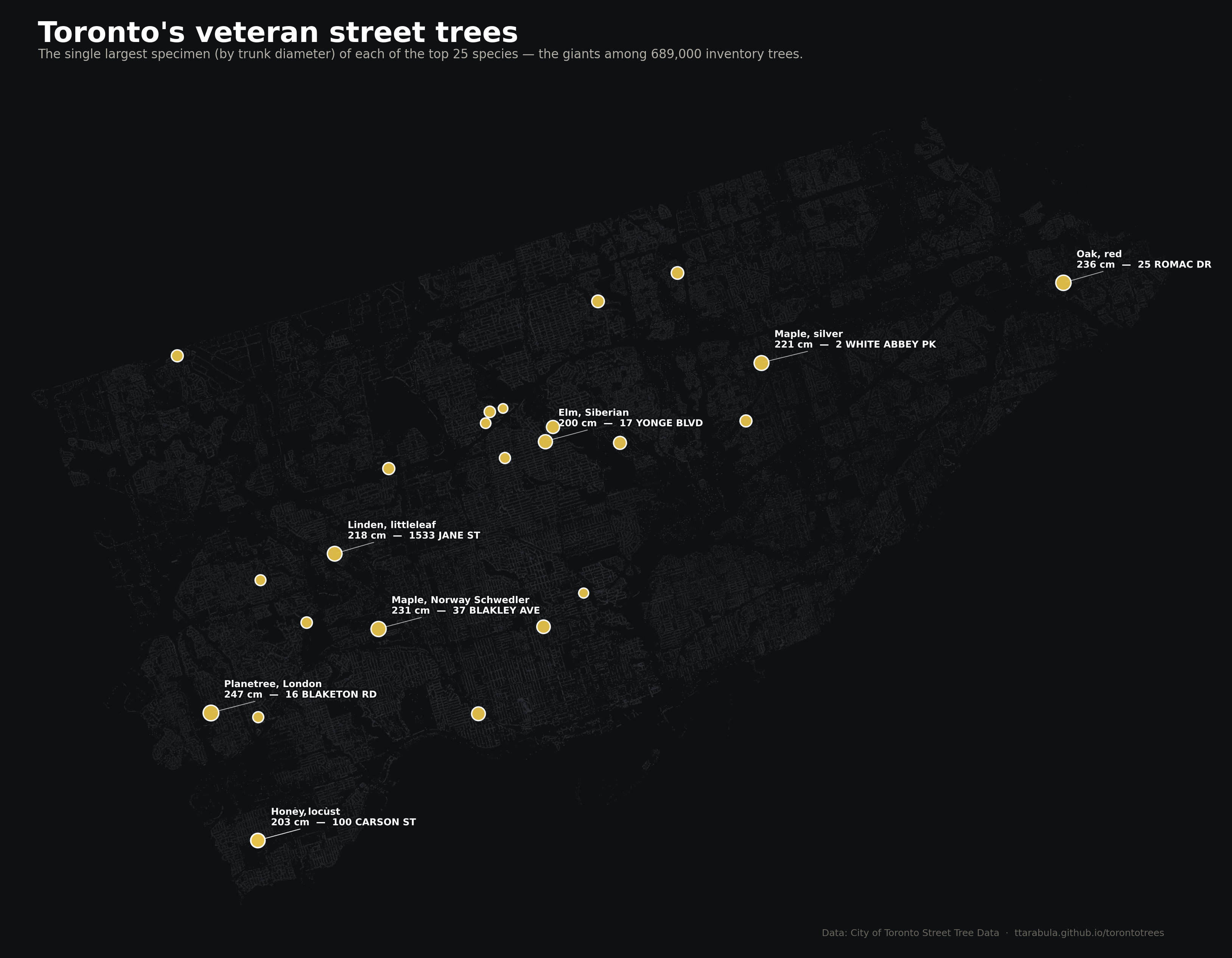
Here they are: the single biggest specimen (by diameter at breast height) of each of Toronto's 25 most-common street-tree species. One veteran per species, ordered by size. Every address is clickable; Street View opens on the actual tree.
The ranked list
Click any row to peek at the tree in Street View.
Click any row below to load a Street View panorama at that tree.
| Species | DBH | Address | Where | |
|---|
| London plane Platanus × acerifolia | 247 cm | 16 Blaketon Rd | Islington |
| Red oak Quercus rubra | 236 cm | 25 Romac Dr | Highland Creek |
| Norway maple, Schwedler Acer platanoides 'Schwedleri' | 231 cm | 37 Blakley Ave | Rockcliffe-Smythe |
| Silver maple Acer saccharinum | 221 cm | 2 White Abbey Pk | Wexford/Maryvale |
| Littleleaf linden Tilia cordata | 218 cm | 1533 Jane St | Brookhaven-Amesbury |
| Red maple Acer rubrum | 210 cm | 100 Carson St | Alderwood |
| Honey locust Gleditsia triacanthos | 203 cm | 100 Carson St | Alderwood |
| Siberian elm Ulmus pumila | 200 cm | 17 Yonge Blvd | Lawrence Park North |
| American elm Ulmus americana | 190 cm | 103 West Lodge Ave | Roncesvalles |
| Bur oak Quercus macrocarpa | 183 cm | 179 Spadina Rd | Annex |
| Paper birch Betula papyrifera | 172 cm | 33 Donino Ave | Bridle Path-Sunnybrook-York Mills |
| Austrian pine Pinus nigra | 168 cm | 16 High Point Rd | Bridle Path-Sunnybrook-York Mills |
| American basswood Tilia americana | 160 cm | 12 Page Ave | Bayview Village |
| Japanese lilac Syringa reticulata | 158 cm | 10 Sandbourne Cres | Don Valley Village |
| Serviceberry Amelanchier canadensis | 146 cm | 266 Cornelius Pkwy | Downsview |
| Callery pear Pyrus calleryana | 144 cm | 96 Anthia Dr | Humber Summit |
| Sargent crabapple Malus sargentii | 143 cm | 10 Carnforth Rd | Victoria Village |
| Sugar maple Acer saccharum | 130 cm | 179 Edenbridge Dr | Edenbridge-Humber Valley |
| Tulip tree Liriodendron tulipifera | 130 cm | 5 Westgate Cres | Lansing-Westgate |
| Ginkgo Ginkgo biloba | 123 cm | 469 Melrose Ave | Bedford Park-Nortown |
| Freeman maple 'Autumn Blaze' Acer × freemanii | 121 cm | 995 Kipling Ave | Islington |
| Kentucky coffeetree Gymnocladus dioicus | 118 cm | 19 Tallon Rd | Willowridge-Martingrove-Richview |
| Colorado blue spruce Picea pungens | 111 cm | 221 Delhi Ave | Lansing-Westgate |
| Hackberry Celtis occidentalis | 100 cm | 90 Summerhill Ave | Rosedale-Moore Park |
| White spruce Picea glauca | 92 cm | 26 Tregellis Rd | Lansing-Westgate |
Four specimens worth the trip
The 247-cm London plane at 16 Blaketon Rd (Islington). A 2.5-metre trunk diameter, meaning its circumference is nearly 8 metres — wider than a Toronto semi-detached garage is deep. London plane (a hybrid of American sycamore × Oriental plane) is mottled-bark, urban-tolerant, and grows extremely large where given space. This is probably the biggest street tree in Toronto's inventory.
The 190-cm American elm at 103 West Lodge Ave (Roncesvalles). Dutch elm disease killed most of Toronto's elms in the 1960s and '70s. This one somehow didn't die. At 190 cm DBH it's easily 100+ years old. The city keeps a handful of mature elm survivors like this on a fungicide-injection schedule — it costs money per visit, but losing a 100-year-old elm to a ten-second pathogen injection is a terrible trade. This tree is, in a real sense, being actively kept alive.
The 183-cm bur oak at 179 Spadina Rd (Annex). Bur oak (Quercus macrocarpa) is the signature species of Ontario's lost oak savannas. High Park has one of the last wild oak savanna remnants in the region. This Spadina bur oak isn't in a park — it's on a residential street boulevard — but it probably predates the subdivision around it. A 180-cm bur oak in Toronto is 150+ years old, meaning it was there when the Annex was still farmland, and possibly before the railway arrived.
The 203-cm honey locust AND 210-cm red maple at 100 Carson St (Alderwood). Two species, same address, both over 200 cm — either the inventory double-counted a single massive tree under two species labels (possible), or there are two genuinely enormous trees growing at the same property (possible in a large corner lot in Alderwood). Either way, Carson St is worth walking.
The pattern on the map
A quick scan of the map surfaces something: the veteran trees are not evenly distributed. Of the top 5, three are in Etobicoke's Islington/Alderwood area, which was farmland + cottage country until after WW2 and retained a lot of pre-urbanization trees when the subdivisions came in. One is in Highland Creek in far-east Scarborough, another former rural corner that grew around existing mature canopy. Central Toronto (downtown, midtown, Leaside) is mostly absent — those neighbourhoods have big canopies, but their trees were planted with the streets, not preserved from before, and peak out smaller.
The veterans live, in other words, on the edges of the old city. They're trees that were here when the subdivisions arrived and got incorporated into the boulevard by accident.
Caveats
- DBH measurements vary. The city's data is collected by multiple inspectors over years. A single-point measurement on a burly trunk can easily have ±10% variation. The 247-cm London plane might be 230; the 236-cm oak might be 250. Ordinal rank is more robust than exact number.
- Inventory cap. The raw Street Tree Data occasionally contains outlier DBH values (we've seen 9,380 cm — clearly an error). I cap at 250 cm in processing; anything genuinely at or above that cap is in the parks or ravines, not on the street-tree roll.
- Street trees only. The single biggest tree in Toronto is almost certainly in a park or a ravine, not on a road allowance. High Park, Taylor Creek Park, and the Humber / Don valleys contain considerably older specimens. This post is about the biggest catalogued tree the city manages on public boulevard land — the ones you can find, reliably, on a map.
Find the biggest tree on your own block.
Search any street — tree cards include the DBH that ranks each one.
Search a street →