April 2026 · species portrait #3
The ginkgo — Ginkgo biloba
Ginkgos are evolutionary orphans. The genus Ginkgo first appears in the fossil record roughly 270 million years ago, before the dinosaurs. At one point there were dozens of ginkgo species spread across what became North America, Europe, and Asia. Every single one went extinct except Ginkgo biloba, which clung on in a tiny area of eastern China. It is the sole living member of its genus, its family, its order, its class, and its entire division Ginkgophyta. When you stand under a ginkgo, you're looking at a plant with no living close relatives. Its nearest cousins have been fossils for 100 million years.
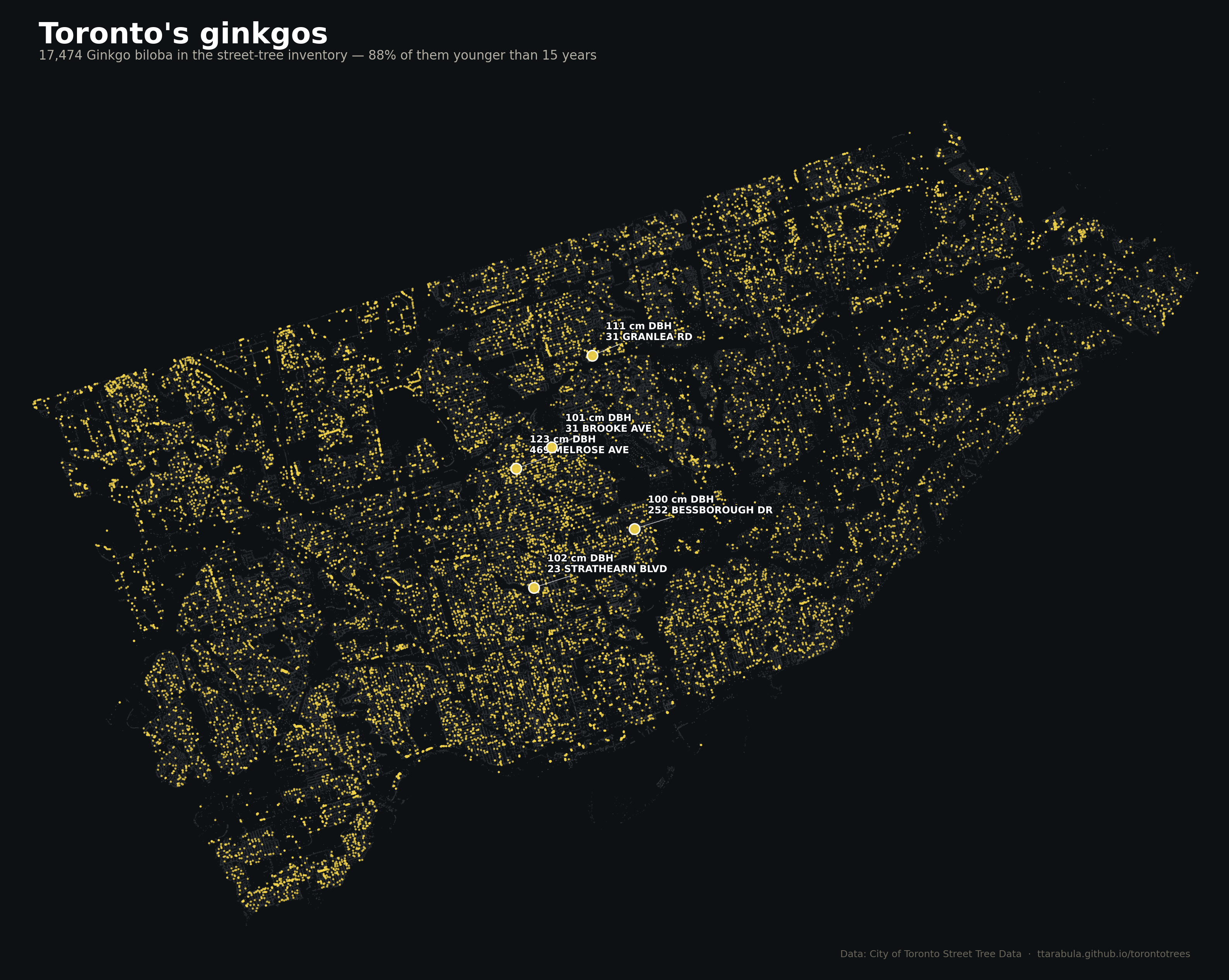
Toronto has 17,474 of them. And 88% are less than 15 cm in trunk diameter — meaning most were planted in the last 15 years. The city has been quietly going all-in on a tree older than flowering plants.
Why cities plant it
It would be easy to dismiss the ginkgo boom as a novelty. It's not. Ginkgos are, from an urban-forestry perspective, almost perfectly engineered:
- Nothing eats them. Ginkgos produce anti-insect compounds (ginkgotoxin, bilobalides) with no modern pest equipped to handle them. You don't see caterpillars on ginkgos. The coevolutionary herbivores that would keep them in check have been extinct for 65 million years.
- Resistant to almost every disease. No bacteria, fungi, or viruses of any significance attack ginkgo in urban settings. Dutch elm disease, emerald ash borer, Asian longhorned beetle — none of them can touch it.
- Tolerant of everything urban. Road salt, compacted soil, air pollution, heat, drought, shade. Ginkgos were literally hand-picked by Japanese temple gardeners for their ability to live in hard places, and the 1,200-year-old ginkgos still standing at Zenpuku-ji in Tokyo prove it.
- Narrow crown. Naturally columnar growth habit fits narrow downtown boulevards and plays nicely with overhead wires — which is why they're a favourite for the city's planting guide.
They also do a decent job of the ecosystem services that pay for their planting — carbon, stormwater, air filtering, summer shade. Not as much per tree as a mature oak, but more than a small ornamental, and bulletproof where oaks aren't.
The male-only city
Ginkgos are dioecious — separate male and female trees. This is rare in the plant world, and in the ginkgo's case it's a problem: the female trees produce a fleshy-seeded "fruit" (technically a naked seed coated in pulpy tissue called a sarcotesta) that, when it drops and rots on a sidewalk, smells exactly like rancid butter and vomit. The compound responsible is butyric acid, the same molecule that makes spoiled dairy offensive.
So Toronto, like most cities that plant ginkgos, plants only males. They're grown from cuttings or grafts of known-male parent trees, and sold as such by nurseries. 'Autumn Gold' (729 in Toronto) and 'Princeton Sentry' are two patented male clones. If you ever smell the fruit of a female ginkgo in Toronto, it's escaped from private property or wandered in from a mistakenly-sexed nursery batch. Very few exist on the street.
The city is, in effect, running a slow-motion genetic bottleneck on its ginkgo population. Every street ginkgo is a male clone, often from only a handful of parent trees. In biodiversity terms this is barely different from a single tree copied 17,000 times. The reason we can get away with this: ginkgos have essentially no natural enemies and no disease vulnerabilities, so the monoculture risk that matters for Norway maples or honey locusts doesn't apply here. Probably. As far as we know.
The overnight drop
Most deciduous trees shed their leaves over three to five weeks in autumn. Ginkgos do it in one or two days. One evening in late October or early November the leaves turn brilliant gold; the next morning there's a ginkgo-shaped puddle of gold on the sidewalk and the tree is bare. The coordinated drop is triggered by a sudden cold night — the tree's abscission layers form in parallel and let go simultaneously.
It is, objectively, one of the most photogenic moments in the city's calendar. The ginkgo grove at Bloor and High Park (where Bloor has 107 ginkgos in a tight stretch) is Toronto's best spot to witness it. The waterfront promenade along Lake Shore Blvd W through New Toronto and Long Branch (139 ginkgos combined) is another. Timing varies year to year; follow local naturalist accounts in late October for the tip-off.
Hiroshima survivors
Six ginkgos stand within 2 km of the hypocenter of the 1945 atomic bomb at Hiroshima. All six were severely damaged — most of their structures destroyed — and all six re-sprouted from the base the following spring. They are still alive. Every mature ginkgo you see carries some share of that species-level resilience: the ability to be knocked down and come back. It is not a casual tree.
Where Toronto's ginkgos live
Unlike the black locust (which concentrates in heritage districts) or the honey locust (which dominates downtown), the ginkgo is scattered broadly across Toronto — but weighted toward recent planting contexts:
| Neighbourhood | Ginkgos |
|---|
| West Humber-Clairville | 789 |
| York University Heights | 446 |
| High Park-Swansea | 335 |
| Humber Summit | 296 |
| Stonegate-Queensway | 279 |
| Mount Olive-Silverstone-Jamestown | 267 |
| Banbury-Don Mills | 267 |
| Bedford Park-Nortown | 252 |
The top four are all north-west suburban neighbourhoods — large-lot 1960s-80s subdivisions where the city has been replacing ash and Norway-maple losses with ginkgos as part of the post-EAB replanting wave. This is the pattern you see when a city has committed to a new species and is putting it in wherever new planting space opens.
The most concentrated ginkgo rows:
| Street | Neighbourhood | Ginkgos |
|---|
| Bloor St W (High Park stretch) | High Park-Swansea | 107 |
| Lake Shore Blvd W | New Toronto | 72 |
| Lake Shore Blvd W | Long Branch | 67 |
| The Queensway | High Park-Swansea | 60 |
| Don Mills Rd | Flemingdon Park | 51 |
| Homewood Ave | North St.James Town | 42 |
| Sheppard Ave W | Glenfield-Jane Heights | 42 |
These are the streets to walk in late October when the drop is imminent.
The giants (such as they are)
Because ginkgos are so new to Toronto, there are no giants yet — the largest specimens on the inventory are barely over a metre in diameter. But here are the five biggest, each at a well-established residential address:
All five are around 100 cm DBH and likely 80–120 years old, so they predate most modern planting campaigns. Ginkgos in favour with mid-20th-century homeowners would have been planted as specimen trees on generous lots. These are the ghosts of that era, still doing their species-level work of staying alive.
The long bet
If Toronto's current ginkgo population survives (and given the species' track record, most of them will), those 15,000 young trees planted in the last decade will be 80-cm veterans by 2100. The city will have, by accident of forest-management policy, a significant ginkgo canopy — one of the largest concentrations of this species outside of east Asia.
Which is a strange kind of urban planning decision. We're using a tree from the Permian to make our sidewalks work in the Anthropocene. The tree doesn't seem to mind. It's done stranger things.
Is the tree in front of your house a ginkgo?
Find out →