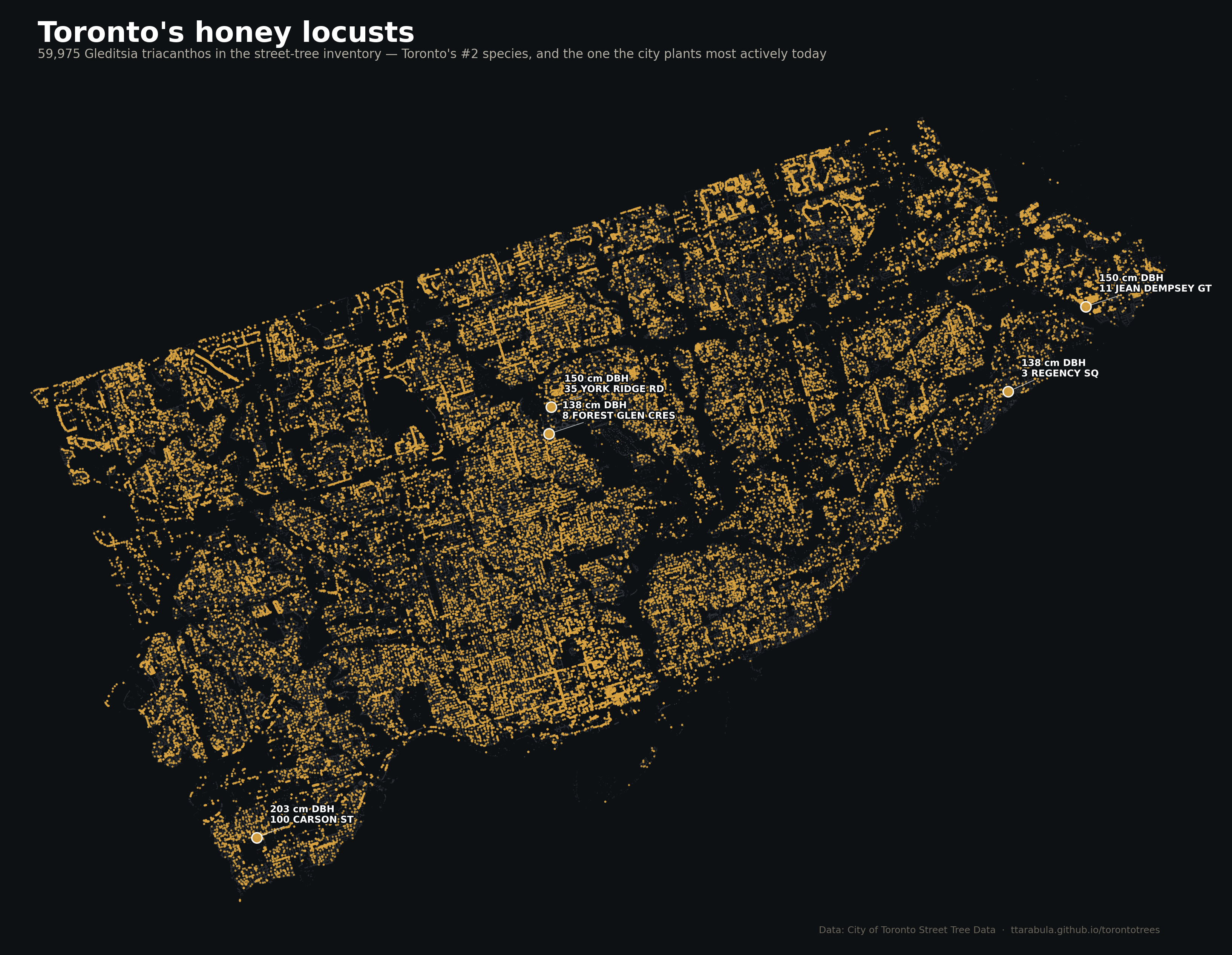
A native species Toronto had to domesticate
Honey locust is native to the southern Ontario–Ohio–Mississippi corridor, with Toronto sitting close to the northern edge of its natural range. In its wild form, it's an aggressive tree: long arching limbs armed with 10-cm thorns (sometimes in clusters, sometimes in branched Christmas-tree-shaped arrangements on the trunk itself), and dangling 30-cm bean pods full of sticky sugary pulp that stains sidewalks and attracts wasps. A wild honey locust in a street pit would be a liability lawsuit waiting to happen.
So we took it to the nursery and fixed it. The cultivars Toronto actually plants — all of them patented, all of them f. inermis ("unarmed," meaning thornless) — are mutations and selections that stripped the wild tree of its weapons and its fruit:
| Cultivar | Trees | What's engineered in |
|---|
| Wild-type Gleditsia triacanthos | 27,779 | Older plantings, some still with thorns/pods |
| 'Skyline' | 16,241 | Thornless, seedless, pyramidal crown — columnar for narrow streets |
| 'Shademaster' | 11,806 | Thornless, seedless, broader spreading crown — classic "street canopy" form |
| 'Sunburst' | 3,815 | Thornless, seedless, yellow-gold spring foliage — ornamental |
| 'Ruby Lace' | 334 | Thornless, purple-bronze new growth — decorative |
A little over half of Toronto's honey locusts are these named cultivars — a remarkable ratio for any genus. Most common street trees are planted as nondescript nursery stock, but honey locust is different. The species had to be bred into something a city could live with.
Why cities plant it
Honey locust (in its civilized form) ticks every box a tree-planting manager cares about:
- Tolerates urban abuse. Salt spray, compacted soil, air pollution, road-surface heat, alkaline pH. You can plant a honey locust in a 1-cubic-metre sidewalk cut-out and it will live.
- Filtered shade. The leaves are compound and tiny — each leaflet the size of a fingernail — so the shade is dappled rather than dense. Pedestrians get cool without feeling in a cave. Grass can grow underneath. Lights reach the sidewalk at night.
- Overhead-wire compatible. Mature height 15–17 m, narrower crowns (especially 'Skyline'), flexible branching — won't tangle in utility lines.
- Bright yellow fall color. The compound leaves drop as a shower of small golden leaflets, not clogging storm drains the way single big maple leaves do.
- Nitrogen fixer. Pea-family, like its distant cousin black locust — fertilizes its own soil.
- Disease-resistant. Not vulnerable to Dutch elm disease, emerald ash borer, Asian longhorned beetle, or most foliar fungal issues.
That last point is worth sitting with. Honey locust became Toronto's go-to partly because so many other species kept dying. Elms were gone by the 1970s. Chestnuts by the 1950s. Ash by the 2010s. Norway maple we turned out to regret. Honey locust stood.
Downtown's honey-locust problem
If you look at the neighbourhoods where honey locust is most dominant as a share of total street trees (not just count), a sharp pattern emerges:
| Neighbourhood | Honey locust % |
|---|
| Downtown Yonge East | 36.6% |
| Yonge-Bay Corridor | 33.0% |
| Bay-Cloverhill | 26.7% |
| Wellington Place | 26.0% |
| Kensington-Chinatown | 22.5% |
| Moss Park | 21.7% |
| Humber Summit | 17.5% |
| Yonge-Doris | 17.4% |
More than a third of every city-owned street tree in Downtown Yonge East is a honey locust. A third. These are also some of our lowest-canopy neighbourhoods (4–10% canopy cover), which means the honey locust monoculture isn't diluted by anything — the few trees downtown has are overwhelmingly one species.
The last time Toronto leaned this heavily on a single genus, it was elms — and we lost most of them to Dutch elm disease in the 1960s and '70s. It happened again with ashes, when emerald ash borer arrived in the 2010s. Every generation of foresters apparently has to re-learn that monocultures are fragile.
Honey locust has its own pest: the mimosa webworm (Homadaula anisocentra), a non-native moth whose caterpillars strip honey-locust foliage and cover infested trees in silky webbing. It's established in Toronto. It's currently a nuisance pest, not a population-threatening one. Whether that stays true depends on climate, biocontrol, and luck. If a resistant honey-locust pest or disease ever gets a foothold, downtown's street-tree canopy would gut itself in a decade.
The city knows this. Newer planting lists emphasize diversification: more Kentucky coffeetree, more oak, more hackberry, more lindens, more ironwood. But replacing honey locust at scale takes decades. For now, Downtown Yonge East's canopy is essentially hostage to a single species' health.
The giants
The 203-cm Alderwood specimen on Carson St is genuinely enormous — a 2-metre trunk diameter puts it in old-growth territory for a species that isn't famous for living long. Most honey locusts max out around 100-120 cm DBH and 80 years old. This one is probably an outlier — maybe a wild-type pre-cultivar specimen planted when Alderwood was still farmland. Worth a visit.
On your block
If you have a honey locust in front of your house, it will be leafing out late (mid-May) and dropping its leaves late (late October) — both ends of the growing season shifted to mitigate frost damage on small leaves. The flowers in June are small and greenish and nearly unnoticeable. You might see the pods in fall if you're near a wild-type, but the cultivars won't produce them. The fall color is pure yellow, brief but clean.
Most of all, it's a polite tree. No messy fruit, no aggressive roots, no ice-storm brittleness, no allergenic pollen, no surface suckers. The price of politeness is predictability: a whole lot of honey locust trees in a whole lot of Toronto neighbourhoods, all fine, all interchangeable, and — eventually, some generation — all vulnerable to the same thing.
Is the tree in front of your house a honey locust?
Find out →