Species profile
Honey Locust
Gleditsia triacanthos
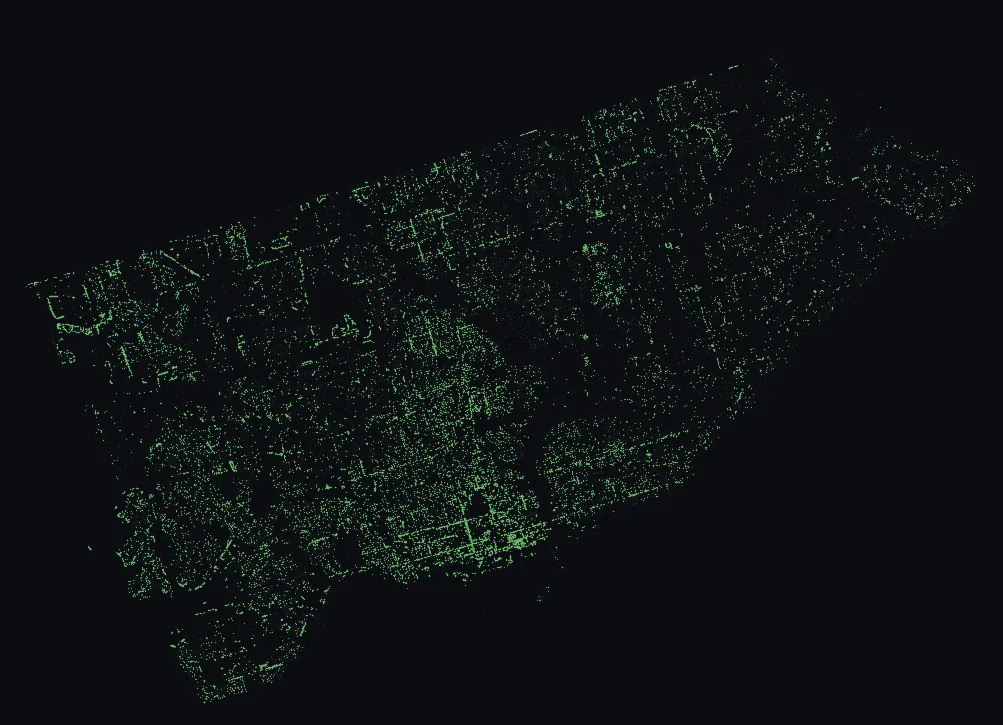
27,758 on Toronto's streets — 4.03% of the city's catalogued canopy.
🌸 Blooms Jun 5 – Jun 15: inconspicuous green, easily missed
🍁 Fall colour Oct 15 – Nov 5: clear yellow, tiny leaves drop cleanly
Toronto history — Ontario-native. Became the city's go-to replacement species after Dutch elm disease cleared the elms in the 1970s. Toronto plants mostly engineered thornless-seedless cultivars ('Skyline', 'Shademaster', 'Sunburst') — not the wild form.
The honey locust, also known as the thorny locust or thorny honeylocust, is a deciduous tree in the family Fabaceae, native to central North America where it is mostly found in the moist soil of river valleys. Honey locust trees are highly adaptable to different environments, and the species has been introduced worldwide. Outside its natural range it can be an aggressive, damaging invasive species
Planting profile (from the City of Toronto)
| Native to | Native to Ontario |
| Mature size | Large, 17m high by 15m wide |
| Growth rate | Fast |
| Sensitivity | Very Hardy |
| Best site | Lawns and boulevards |
| Of note | Provides filtered shade |
| Plants under overhead wires | Yes |
Where they cluster
| Neighbourhood | Trees |
|---|---|
| West Humber-Clairville | 1,262 |
| Kensington-Chinatown | 485 |
| York University Heights | 458 |
| Bedford Park-Nortown | 455 |
| Annex | 435 |
| Humber Summit | 426 |
| Etobicoke City Centre | 420 |
| Eringate-Centennial-West Deane | 419 |
Notable specimens
- 150 cm DBH at 11 JEAN DEMPSEY GT · view →
- 138 cm DBH at 8 FOREST GLEN CRES · view →
- 130 cm DBH at 790 QUEEN ST W · view →
- 120 cm DBH at 28 CANNON RD · view →
- 119 cm DBH at 45 BRADDOCK RD · view →
- 112 cm DBH at 207 SCARBOROUGH GOLF CLUB RD · view →
- 111 cm DBH at 129 GLEBEMOUNT AVE · view →
- 110 cm DBH at 37 TOYNBEE TRL · view →