September 2026 · on the new tree bylaw
On September 1, 2026, Toronto's tree rules get stricter. The headline change is a new protected category: a private tree measuring 61 centimetres or more in diameter becomes a distinctive tree, and its status has to be weighed when someone applies for a permit to remove it. Alongside that, the city can now use a stump 40 cm or wider as evidence that a protected tree came down without permission; roughly 30,000 households in ravine-protected areas will pay permit fees for the first time ($87 to $632); trees planted through enforcement orders or development approvals are protected regardless of size; and a pilot program will help owners pay to maintain big healthy trees rather than only penalizing them for removal.
It's a real strengthening, and the maintenance pilot in particular is the rare piece of tree policy that offers a carrot. But 61 centimetres is a strange kind of number — an objective measurement standing in for a subjective idea. "Distinctive" is doing a lot of work, and a tape measure is being asked to decide it.
So: what does that line actually select for?
I can't answer that for private trees. Nobody can — Toronto has never published an inventory of them. But the city does publish every tree it owns on the road allowance, all 689,013 of them, each with a diameter. Running the bylaw's own threshold across that dataset is the closest available approximation of what a 61-centimetre rule catches in this city. And it catches two things the bylaw never mentions.
49,264 city-owned street trees measure 61 cm or more — 7.1% of the inventory. The 40 cm stump threshold is a much wider net: 150,447 trees, 21.8%, would leave a stump big enough to trigger the evidentiary rule.
Seven percent sounds low until you remember what a street tree's life is actually like. The median Toronto street tree is 17 cm across — about the width of a dinner plate. Most trees on most streets are young, because most of them are replacements, and because a boulevard tree lives a fraction of what its species could manage in a forest. Getting to 61 cm on a Toronto street means surviving several decades of salt, compaction, utility pruning and snow ploughs. It is genuinely a filter for age.
Which is exactly why the species it selects are so awkward.
| Species | ≥ 61 cm | All sizes | % of species | Share of all big |
|---|---|---|---|---|
| Norway maple | 12,745 | 99,931 | 12.8% | 25.9% |
| Silver maple | 10,128 | 20,863 | 48.5% | 20.6% |
| Littleleaf linden | 4,477 | 27,360 | 16.4% | 9.1% |
| Red oak | 2,665 | 23,720 | 11.2% | 5.4% |
| Honey locust | 1,928 | 59,975 | 3.2% | 3.9% |
| Siberian elm | 1,669 | 9,816 | 17.0% | 3.4% |
| White oak | 952 | 3,807 | 25.0% | 1.9% |
The top two are Norway maple and silver maple, which together account for 46.4% of every distinctive-sized street tree in Toronto — 22,873 of 49,264.
Norway maple is the species I've written about before: the most-planted tree in the city, and one it no longer plants, because it is invasive, casts shade so dense that nothing grows beneath it, and seeds itself into every ravine it can reach. Silver maple is the other kind of regret — fast, brittle, prone to dropping limbs in ice storms and lifting sidewalks with surface roots. Nearly half of all silver maples on Toronto streets (48.5%) are already over the line, because they grow quickly and were planted in bulk in the mid-twentieth century.
Meanwhile honey locust — the workhorse the city planted 59,975 of, the safe modern choice — contributes just 3.2% of its own population to the distinctive tier, because most of them are young.
This isn't an argument against the rule. A big Norway maple is still shade, still stormwater interception, still summer cooling on a street that would otherwise bake, and you cannot replace a 70 cm canopy with a 5 cm whip. It's an argument that "distinctive" and "desirable" are different words, and the bylaw has quietly picked the first one.
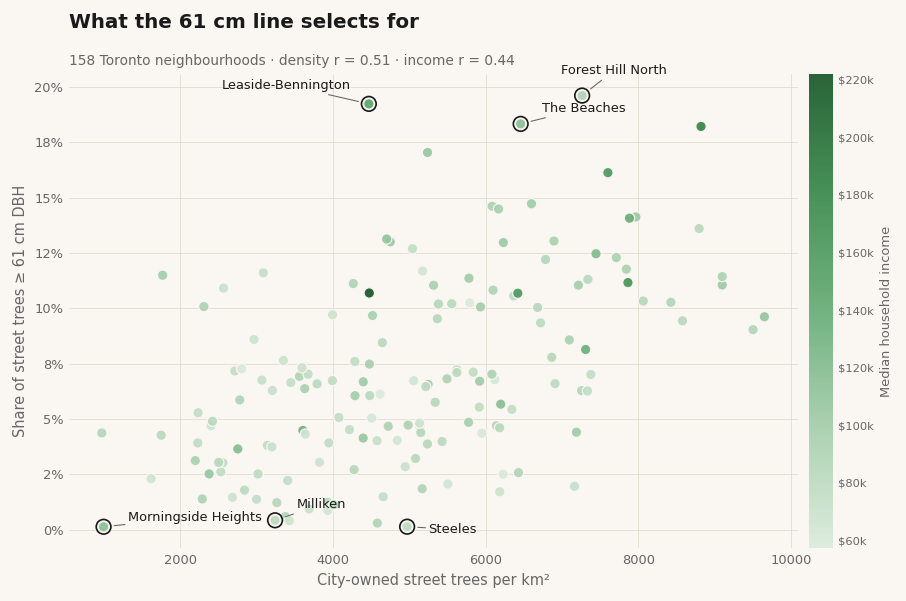
Here's where it gets uncomfortable. Sort neighbourhoods by the share of their street trees that clear 61 cm:
| Neighbourhood | Street trees | ≥ 61 cm | Share | Median income |
|---|---|---|---|---|
| Forest Hill North | 2,918 | 572 | 19.6% | $90,000 |
| Leaside-Bennington | 5,497 | 1,057 | 19.2% | $148,000 |
| The Beaches | 6,003 | 1,100 | 18.3% | $116,000 |
| ··· | ||||
| Milliken | 8,007 | 34 | 0.4% | $81,000 |
| Morningside Heights | 7,526 | 10 | 0.1% | $117,000 |
| Steeles | 5,868 | 8 | 0.1% | $80,000 |
Look carefully at the second and fifth rows. Morningside Heights has more than twice as many street trees as Forest Hill North — 7,526 against 2,918 — and 10 distinctive ones against 572. Not ten percent as many. Ten.
That gap is not what a tree-count map shows you. Scarborough's postwar subdivisions are not tree-poor by number; several of them are comfortably above the city average. They are tree-young. And a bylaw written around size treats young and absent identically.
Aggregate it by income and the expected pattern does appear:
| Income quintile | Street trees | ≥ 61 cm | Share |
|---|---|---|---|
| Q1 — lowest income | 85,275 | 4,791 | 5.6% |
| Q2 | 134,229 | 6,097 | 4.5% |
| Q3 | 136,746 | 8,020 | 5.9% |
| Q4 | 132,246 | 9,861 | 7.5% |
| Q5 — highest income | 200,517 | 20,495 | 10.2% |
The richest fifth of Toronto's neighbourhoods holds 41.6% of all distinctive-sized street trees. If you stopped reading here you'd conclude the new rule is a wealth story, and I nearly did.
Forest Hill North has a median household income of $90,000. Morningside Heights has $117,000. The richer neighbourhood is the one with ten big trees.
Across all 158 neighbourhoods, the share of street trees clearing 61 cm correlates with street-tree density — my proxy for an old, narrow, pre-car street grid — at r = 0.51, and with median household income at r = 0.44. Restrict the comparison to just the richest 40% of neighbourhoods and income nearly stops explaining anything (r = 0.31) while grid density holds steady (r = 0.49). Wealth correlates with big trees mostly because Toronto's wealthy neighbourhoods are disproportionately its old ones.
This is the same finding as the narrow-street advantage, one generation of tree further along. A prewar grid gives a tree a real boulevard to live in; a postwar arterial gives it a strip of salted turf between a sidewalk and six lanes. The first produces 61 cm trees eventually. The second mostly doesn't, no matter who lives there.
The Distinctive Tree Maintenance Incentive pilot is the part of this package I like most — money toward pruning and care for large healthy private trees, on the sensible theory that keeping a mature tree alive beats replacing it. But eligibility keys off the same 61 cm line, and on the public side of the property line that line points hard at old grids. If private trees follow anything like the same distribution — and there is every reason to think they follow it more strongly, since private lots in postwar subdivisions are younger still — then a size-gated subsidy will send most of its money to the neighbourhoods that already have the canopy.
There's a version of this policy that doesn't do that: fund establishment where the trees are young, not just maintenance where they're old. Toronto already knows how — it just tends to fund it separately, and less.
One number for the optimists: 41,282 street trees are currently between 50 and 61 cm. That's a cohort roughly 84% the size of the current distinctive tier sitting one good decade below the line. Where those trees are is where the map changes next.
Everything above is about city-owned street trees. The bylaw that changes on September 1 governs private trees and ravine trees — a set this dataset does not contain a single row of. I've used the street inventory as a proxy for a population nobody has measured, and proxies are wrong in specific ways: private back-yard trees escape the salt, the ploughs and the utility pruning that keep boulevard trees small, so the true private-tree share above 61 cm is probably higher than 7.1%, and the species mix is certainly different.
What the proxy is good for is the shape of the thing — which species a size rule favours, and which streets. Both of those are properties of when a neighbourhood was built, and the property line doesn't change when it was built.
If you want the fuller picture of what Toronto's canopy looks like once you stop caring about ownership, beyond the curb uses the city's LiDAR land-cover data, and the ravines covers the five to eight million trees that live in the 17% of Toronto nobody inventories tree by tree.
Find the big ones near you:
Toronto's veteran street trees →